


Have you ever experienced an animal performing a behavior perfectly with you... but with another trainer it's as if they know nothing? Or the opposite, that it begins to show a trained behavior at completely unexpected times? In both cases, you're probably dealing with two sides of the same coin: generalization and discrimination of behavior.
Although it may sound strange, these concepts are present in every training session, even when we don't realize it. They are as important as positive reinforcement or the bridge itself, and understanding them deeply can make the difference between a truly functional behavior and one that just seems "learned."

What is generalizing?
Generalizing, in simple terms, is when a learned behavior "transfers" to new situations without having been specifically trained for them. It's like when you teach a dog to sit at home, and then it also does so in the park, on the street, or at the vet clinic. In this case, we would say the behavior has been generalized. In animal training, this doesn't happen by magic. It requires planning.
For example, if a dolphin learns to present its tail fluke for a medical check-up with its trainer in a specific location, that doesn't guarantee it will do so with the vet in a different location. For that to happen, we must actively work on progressive exposure to variations in environment, people, and conditions
We must keep in mind that a behavior is not truly complete until its reliability has been proven in different contexts. It may not be necessary to generalize a behavior in every possible situation you can imagine, but it does need to be likely in the vast majority of them. For example, going back to the dolphin presenting the tail fluke for a blood draw. It will be necessary for the dolphin to have the behavior generalized in different pools, with different social groups, another trainer, in the morning, in the afternoon, and even whether it is healthy or sick!
Hence the great importance of secondary reinforcers we've discussed in previous articles like "What leads an animal to perform a behavior," because if the behavior is well trained, when we have a sick animal there is still room for that animal to rely on its relationship with the trainer to perform the behavior and voluntarily give a blood sample successfully without needing to use primary reinforcement, since we understand that one of the first symptoms of a sick animal is often loss of appetite

What is Discrimination?
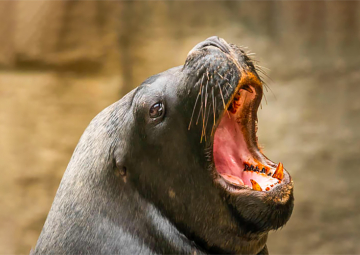
This is where the other side of the coin comes in. To discriminate—behaviorally speaking—means knowing when and with what signals to perform a behavior, and when not to. If everything were generalized without control, we'd have animals throwing themselves into any behavior without anyone asking for it. That's why teaching discrimination is just as important as teaching generalization. It involves creating clear, consistent, and well-reinforced cues. Karen Pryor explained it very elegantly in her classic "Don't Shoot the Dog": the key is that the animal understands which signal activates the behavior and doesn't do it in its absence. For example, if you're training a sea lion for a mouth check, you would logically train it to open its mouth, but you don't want it to constantly open its mouth every time it sees you appear! Right? That's why you must train both the cue to open the mouth and the act of not opening it when you haven't asked.
The balance between the two
Although they may seem like opposites, generalization and discrimination actually go hand in hand. Ideally, the animal generalizes as needed (the behavior can occur in different situations) but discriminates accurately (and only performs it when asked).
What if we don't do it well?
When this dual strategy is neglected, common training problems arise: behaviors that become "disordered," that appear at inappropriate times, or that only work in very specific circumstances. A classic is superstitious behavior, which we also discussed in previous articles like "Silent training." These are types of responses that were not intentionally reinforced but sneak into the animal's behavior chain. Like that sea lion that starts spinning before eating, simply because one time it did and got fish right after. If it's not clear what's being reinforced, these actions can multiply.
How to Train Generalization and Discrimination in Practice
- Plan generalization from the start: change trainers, location, time of day... Reinforce in all the situations where you want the behavior to work. Remember, some details are very important and cannot be overlooked. For example, if you're training for an x-ray, you'll need to simulate the x-ray machine with a box or something similar. You'll need something similar to a lead apron, since the vet will make you wear one on the actual day.
- Mind the cues: they must be clear, unique, and consistent. Constantly changing them or using them ambiguously will only confuse the animal.
- Watch what else happens during reinforcement: sometimes we unintentionally reinforce a behavior that wasn't in the plan, and it sneaks into the routine, leading to what we know as superstitious behaviors.
- Test it: does the animal respond only when necessary? With different trainers? In different environments? If not, go back and reinforce those steps.

At Wezooit we believe that generalization allows behavior to become solid. Discrimination prevents it from getting out of control. Without the former, we're limited to one scenario. Without the latter, there's chaos and an unstable animal. And like everything in training, finding the middle ground is a matter of trial, error, and lots of observation. It's fascinating to see how the same behavior can adapt or fall apart depending on how it's worked. And that's where the role of the trainer becomes an art.
And remember, if it's possible... Wezooit!